
12 October 2026
Does Spanish Health Insurance Cover Chiropractic Care?
 Léa Guido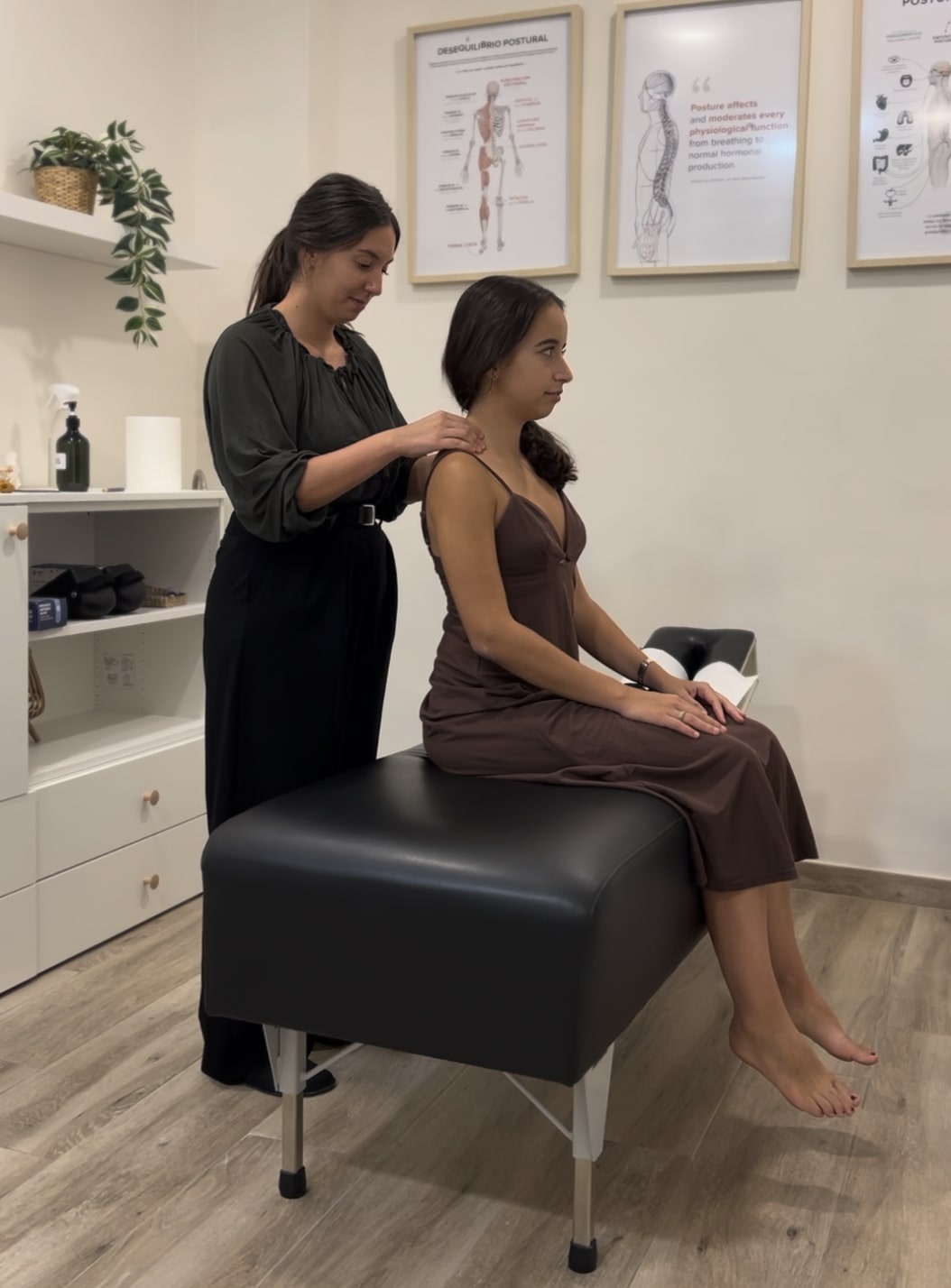
The short answer
The Spanish public health system does not cover chiropractic. It is not in the national catalogue of services.
Most Spanish private policies do not cover it either, at least not the common network-based kind. The route that sometimes works is different: a reimbursement policy, where you pay for the visit, submit the invoice, and get a percentage back.
If your insurance is from your home country rather than Spain, your chances are considerably better — more on that below, because it is the case we see most often with patients who have recently moved here.
Why: the structural reason
Almost every question about this resolves once you understand one thing: chiropractic is not a regulated health profession in Spain. It does not appear in the law that defines which professions are (Ley 44/2003) — that list covers medicine, nursing, physiotherapy, podiatry and the rest.
Two practical consequences follow:
- It is not in the public health service catalogue, which is built around recognised health provisions.
- Insurers build their provider networks from regulated health professions. That is why physiotherapy and podiatry appear in the networks of the big Spanish companies, and chiropractic generally does not.
This is not insurers objecting to chiropractic. The administrative slot simply does not exist in Spain — unlike Switzerland, Denmark, Norway, the UK or the United States, where the profession is regulated and in several cases integrated into public healthcare.
If you are coming from one of those countries, this is the thing that will surprise you most: the care itself is similar, the paperwork around it is not.
If your insurance is from your home country
Worth putting before the Spanish detail, because it is the most likely route to actually getting money back.
International and home-country policies often cover chiropractic far more readily than Spanish ones, precisely because the profession is regulated where the policy was written. If you have kept a UK, Irish, Dutch, German, Nordic or US policy, or you are on an international expat plan, ask them directly rather than assuming Spanish rules apply.
What they will usually want to know:
- that the provider is outside their network, and how they handle out-of-network claims
- the practitioner's qualification, which you can give them: Léa Guido holds a chiropractic degree from the Barcelona College of Chiropractic, a six-year programme
- whether they need the invoice translated, and in what currency they reimburse
Ask what documentation they want before your first visit. It is far easier to have the invoice issued correctly from the start than to get a corrected one reissued later.
The Spanish public system
No nuance here: not included. There is no referral pathway from your GP to a chiropractor, no co-payment arrangement, no waiting list to join.
What the public system can provide, and this is worth not confusing, is physiotherapy on medical referral — a regulated profession and a different discipline. If that is what you need, your médico de cabecera is the way in. We cover the difference in chiropractor or physiotherapist.
Spanish private policies: network vs reimbursement
This distinction decides the answer, and many people do not know which type they hold.
Network policies (cuadro médico). The most common and the cheapest. You see providers from a closed list of contracted professionals and pay little or nothing at the visit. If chiropractic is not on that list — and normally it is not — there is no coverage available this way. It is not negotiable: the provider is simply not in the network.
Reimbursement policies (reembolso). More expensive, and they work the other way round: you choose any provider freely, pay the invoice yourself, and the company returns a percentage, typically 80–90% depending on the policy. There is a genuine possibility here, because the test stops being "is this provider in my network?" and becomes "does my policy reimburse this expense?".
Several Spanish companies offer reimbursement products — Asisa, Sanitas, DKV, Caser, Mapfre, Allianz among others — but the existence of the product does not mean chiropractic is included. That depends on the specific terms you signed, not on the company in the abstract.
Why there is no insurer-by-insurer table here
We could list "Adeslas yes, Sanitas no", and it is what most people search for. We have not, for two reasons:
- Terms vary by product and by year. A single company sells dozens of different products, and what one covers another does not. A table would be wrong for most readers.
- We cannot verify it reliably. Full policy terms are not consistently public, and you will find chiropractic clinic websites asserting that a given company "covers 100%" with no source at all. We would rather not add to that when money is involved.
What we can give you is a way to get the correct answer in five minutes.
The exact questions to ask your insurer
Call the number on your policy, or write through the customer portal — writing is better, because it leaves a record — and ask literally this:
- "Is my policy network-based, or does it include reimbursement?" If it is network-only, you can stop here.
- "Do you reimburse invoices for chiropractic?" Use the word chiropractic (quiropráctica), not physiotherapy or osteopathy — they are different things and the answer can change.
- "What percentage do you reimburse, and what is the annual limit?"
- "Do I need a doctor's referral first?" Some policies only reimburse with a medical report. If that is yours, get it before you start, not after.
- "Exactly what details must the invoice show?"
- "Is there a waiting period?" Meaning an initial stretch of the contract where that cover does not yet apply.
And one practical note: get the answer in writing. A "I think so" over the phone is worth nothing when a claim is refused three months later.
What the invoice needs
If your policy does reimburse, the invoice is the only thing that matters. It should clearly show:
- your full details as the patient, with NIF, DNI or passport number
- the clinic's tax details and tax number
- invoice date and number
- an itemised description of the service and the amount
Before requesting it, ask your insurer how they want the service described. This is where claims most often stall: an invoice reading only "session" can come back refused, while one with the service properly described goes through.
We issue an invoice for every visit at ColumnaQuiro. If yours needs particular details for your insurer, tell us and we will prepare it that way from the first visit.
If you have no cover at all
This is the most common situation, so it is worth addressing directly rather than talking around it.
Without cover, chiropractic is an out-of-pocket expense, and the question shifts from "is it covered?" to "what will this cost in total?". That depends on how many sessions you need, which is an estimate made after assessing you rather than a fixed number — we cover it in how many chiropractic sessions you need, and the cost breakdown in how much a chiropractor costs.
Two things worth knowing before you decide:
- Ask for the full plan in writing before committing. Estimated number of sessions, frequency, and a review date. Without that you cannot work out the real cost, insured or not.
- Be wary of long prepaid contracts sold at a discount. They suit the clinic and not you, if four sessions in it turns out this is not for you.
Frequently asked questions
Can I ask my Spanish GP to refer me to a chiropractor? No such referral exists within the public system, because chiropractic is not part of its catalogue. Your GP can refer you to physiotherapy, which is a different thing.
Would it help if the invoice said "physiotherapy" so it gets reimbursed? Do not do this, and we will not offer it. An invoice has to describe the service actually provided. Misdescribing it is a problem for you and for the clinic, and insurers cross-check the issuing practitioner.
I have work or traffic accident insurance. Does that change things? Those run through mutuas and liability insurers with their own criteria, not through your health policy. Ask whoever is handling the claim before starting any care.
Is a reimbursement policy cheaper than just paying for sessions? Almost never, if chiropractic is the only thing you want covered. Reimbursement policies cost considerably more than network ones, and make sense for the whole range of cover rather than for this.
Is this likely to change? Possibly, but nothing is currently in progress. There have been attempts since 2011 and none has completed, so plan around the situation as it is rather than as it might become.
I am only in Spain temporarily. Does travel insurance cover this? Travel policies typically cover emergencies and acute problems, not elective or ongoing care — so usually no for a course of chiropractic. Check the wording before assuming either way.