
2 November 2025
Is it good to crack your own back?
 Léa Guido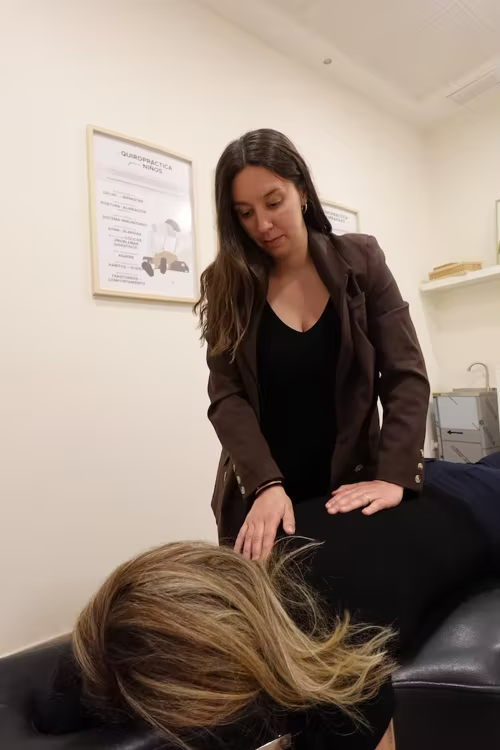
What is that "crack" in your back, really?
That characteristic sound is called cavitation. Inside every joint there's synovial fluid containing tiny bubbles of dissolved gas. When you stretch or move a joint beyond its usual range, the pressure changes and those bubbles suddenly collapse, producing the "pop" we hear.
Is cracking your own back the same as a chiropractic adjustment?
Not quite. When you crack your own back, you tend to move the joint that's already most mobile or has the most play, chasing that feeling of relief, but without control over which segment actually moves. A chiropractic adjustment is a precise technique aimed at the specific joint that's stiff or not moving well, which allows for a more targeted and lasting effect.
Is it bad to crack your back frequently?
Doing it occasionally isn't a serious risk. The problem arises when it becomes a repetitive habit: by always seeking the crack in the same joints (the most flexible ones), those joints can gradually become more unstable, while the areas that are actually stiff still don't get any attention.
When self-cracking can mask an underlying problem
If you feel a constant need to crack your back just to "feel okay," it can be a sign that there's stiffness or misalignment elsewhere in the spine that your body is trying to compensate for. In these cases, chasing the pop alone doesn't address the root cause.
Frequently asked questions
Can cracking your back cause arthritis? There's no scientific evidence linking joint cavitation to the development of arthritis.
Why do I feel momentary relief when I crack my back? The movement stimulates joint receptors and can create a temporary sensation of less tension, although it doesn't always resolve the underlying issue.
Can I hurt myself by cracking my own back? The risk is low if done occasionally, but forcing abrupt, uncontrolled movements can cause muscle discomfort or joint irritation.
What's the real difference compared to seeing a chiropractor? Precision. A professional identifies exactly which segment needs to be mobilized, rather than always moving the most flexible area.
When should I see a professional? If you notice persistent stiffness, need to crack your back several times a day, or the relief lasts a shorter time each time.