
6 November 2025
Updated 31 October 2026
Trapezius pinched nerve: causes, symptoms and relief
What people call a "pinched nerve in the trapezius" is almost always one of two things: an overloaded trapezius muscle (most common), or an irritated nerve in the neck that causes pain in the trapezius and often down the arm. Telling them apart matters, because the outlook and treatment differ. Either way, most people improve within days to a few weeks.
The trapezius in brief
It's the large muscle running from the base of the skull to the shoulders and the middle of the back. It holds and moves the shoulder blades and helps support the head. The upper part, between the neck and the shoulder, is where the "knot" is almost always felt.
Muscle or nerve? How to tell
More likely the muscle if:
- The pain is in the trapezius, between neck and shoulder, and doesn't go past the shoulder.
- You can feel hard, tender spots (trigger points).
- It gets worse at the end of the day, with stress or after hours at a computer.
- Turning or tilting your neck pulls and aches, but doesn't give an electric feeling.
More likely a nerve in the neck (cervical radiculopathy) if:
- The pain travels down the arm, sometimes to the hand.
- There's tingling, numbness or an electric feeling in specific parts of the arm or fingers.
- Your grip feels weaker.
- Tilting your head back and towards the painful side reproduces it, and lifting your arm to rest your hand on top of your head sometimes eases it.
The nerve that powers the trapezius (the spinal accessory nerve) rarely gets "pinched" on its own: when it's injured it's usually after neck surgery or a blow, and it causes shoulder weakness more than pain.
Common causes
- Hours at a screen with your head forward and shoulders raised.
- Stress: many people hunch their shoulders without noticing.
- Sleeping with your neck twisted, for example on your stomach.
- Carrying weight on the same side (bag, backpack, a child on your hip).
- When it's a nerve: a neck disc that bulges, or arthritis narrowing the opening where the nerve root exits. More in cervical disc protrusion.
What you can do at home
- Heat for 15-20 minutes on the trapezius to relax the muscle.
- Keep moving: gently turn and tilt your neck several times a day, without forcing it.
- Drop your shoulders: check a few times a day whether they're raised and let them go.
- Adjust your workstation: screen at eye level, elbows supported, breaks every 30-45 minutes.
- Strengthen: in office workers with chronic trapezius pain, a strength programme for the shoulders and neck (shrugs, rows and lateral raises with dumbbells, three times a week) reduced pain more than general exercise (Andersen et al., Arthritis & Rheumatism, 2008).
- Gentle stretch: tilt your ear towards the opposite shoulder, keeping the stretched-side shoulder down, 30 seconds, pain-free.
If you have tingling in your arm, avoid stretches that make it worse.
How we treat it at the clinic
First we work out whether the source is muscular or a nerve, examining your neck, shoulders, strength, sensation and reflexes. Then we combine:
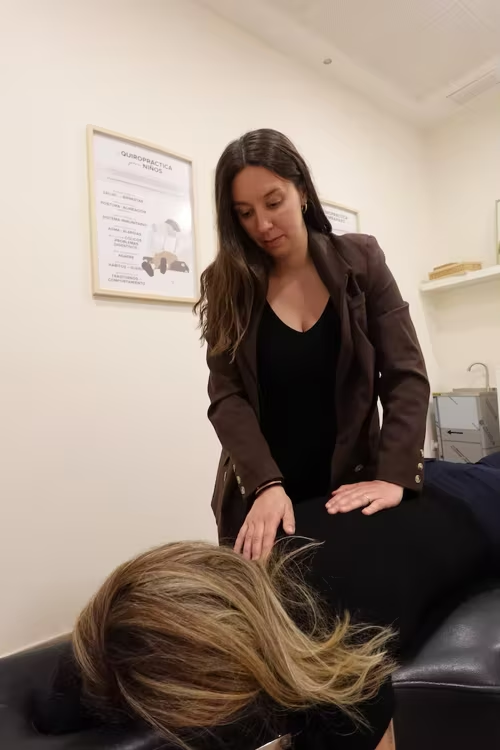
- Gentle adjustments and mobilisation of the neck and upper back where movement is lacking. When there are arm symptoms we use gentle techniques, with no forceful manoeuvres.
- Soft-tissue work on the trapezius and the muscles around it.
- Strength and mobility exercises for home, and specific changes to your workstation.
When to see a doctor first
See a doctor if you have:
- Weakness in your arm or hand that's getting worse.
- Clumsy hands (trouble with buttons or writing) or unsteadiness when walking.
- Pain after a blow or accident.
- Pain with fever, weight loss or a history of cancer.
- Pain in the left shoulder or trapezius with chest tightness, breathlessness or a cold sweat: call 112.
Frequently asked questions
How long does a pinched nerve in the trapezius last? If it's muscular, it usually improves within a few days to two weeks. If it's a nerve in the neck, it can take weeks to a few months, but most people recover without surgery.
Heat or ice? For the trapezius, usually heat. Ice may help more in the first days if the pain came on suddenly and is very sharp. More in heat or ice.
Can it cause headaches? Yes. Tension in the trapezius and neck is a common cause of headaches that start at the back of the head. See our guide to headaches from the neck.
Can I keep training? Yes, adapting exercises that reproduce the pain. Strengthening your shoulders usually helps.
Why does my right (or left) trapezius hurt more? It's usually the side of your mouse, your bag, or the way you turn your head when sleeping or looking at a screen.
Read more

Chiropractor · graduate of the Barcelona College of Chiropractic (2021) · consults in English, Spanish and French